
We’ve all heard the golden rule: “10,000 steps a day.” It’s a mantra repeated on fitness trackers, in wellness articles, and among friends. But what if that number isn’t the whole story? As it turns out, this widely promoted target originated from a Japanese marketing campaign, not from scientific evidence. Thanks to a groundbreaking meta-analysis published in The Lancet, we now have a clearer, age-specific picture of the number of steps required for significant health benefits.
This massive study, which analysed data from 15 international cohorts and nearly 47,500 adults, found that the optimal number of daily steps to lower the risk of all-cause mortality varies significantly by age. It’s a game-changer for anyone trying to build a sustainable wellness routine. So, grab your trainers and get ready to walk with purpose, because here’s your guide to smarter stepping, courtesy of new research and our insights here on the wellness section.

The Lancet is a highly respected and influential British medical journal. It’s one of the oldest and most well-known peer-reviewed medical publications in the world, which is why the findings are worth noting. The main takeaway is this: there is no one-size-fits-all number. Your steps-per-day target should be based on your age, with a clear plateau where the mortality risk no longer decreases significantly.
For Adults Aged 30-59 (The Younger Group)
If you’re in this age bracket, the sweet spot for maximum health benefit is a little higher. The study found that the risk of all-cause mortality progressively decreases with more steps, reaching a plateau between 8,000 and 10,000 steps per day. This suggests that while 10,000 isn’t a magical number, it’s an effective goal for this age group.
● The Goal: Aim for at least 8,000 steps, with 10,000 as an excellent, aspirational target.
● The Insight: The steepest drop in mortality risk happens in the early stages of increasing activity. So, if you’re currently walking 4,000 steps, bumping that up to 6,000 will provide a huge health boost. Every step counts!
For Adults Aged 60 and Above (The Older Group)
This is where the findings are particularly encouraging. If you’re 60 or over, you don’t need to push for 10,000 steps a day to get a significant benefit. The study found that the risk of mortality plateaus at a lower number: 6,000 to 8,000 steps per day. This is great news, as it makes a healthy, active lifestyle more accessible and achievable without the pressure of a higher target.
● The Goal: Aim for a target between 6,000 and 8,000 steps per day for the greatest reduction in mortality risk.
● The Insight: This lower target reflects the physiological differences that come with age, and it shows that even moderate, consistent activity can have a profound impact on health and longevity. As Woman & Home highlighted in their coverage of this report, “it’s a much more achievable goal.”
“
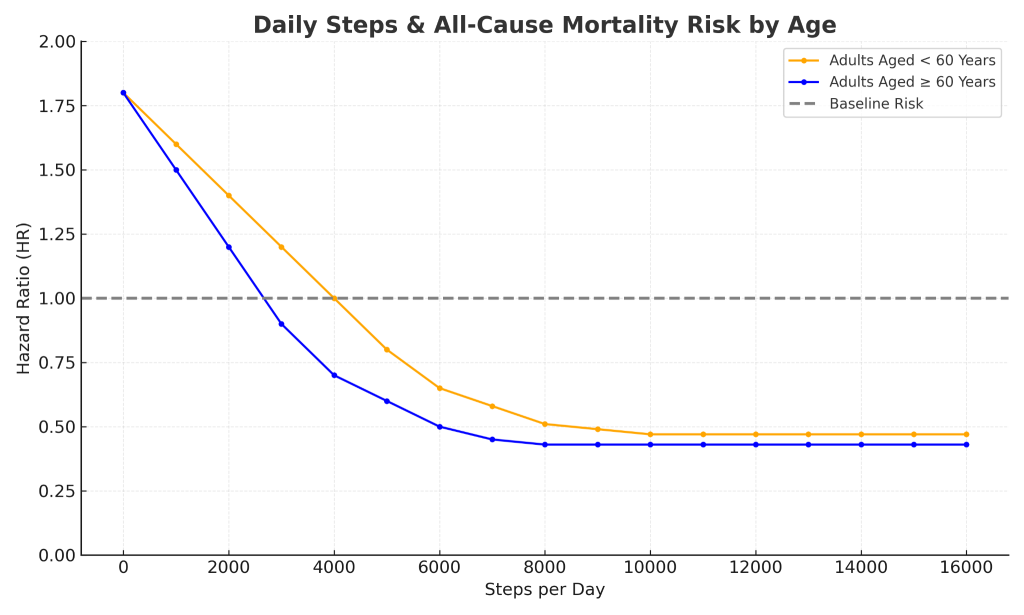
How to interpret this graph:
The Hazard Ratio (HR) on the vertical axis represents the risk of mortality. A value of 1.0 (the dotted line) is the baseline risk.
Any point below 1.0 indicates a lower risk of mortality compared to the baseline (the lowest steps group).
The risk of mortality decreases as steps per day increase for both age groups.
The benefit plateaus at different points: 8,000-10,000 steps for adults under 60, and 6,000-8,000 for those 60 and older.

Beyond the compelling mortality data, walking is a powerful tool for holistic wellness. It’s a low-impact exercise with a cascade of benefits for your entire body. Regular walking is excellent for enhancing blood flow and heart health, strengthening the cardiovascular system, and helping to regulate blood pressure.
Walking also directly benefits joint mobility, as consistent movement helps to lubricate and strengthen the muscles surrounding the ankles and knees, thereby enhancing stability and reducing the risk of injury. Furthermore, walking engages and strengthens the often-neglected hip flexors, which are essential for maintaining good posture and overall mobility. It’s a simple, daily practice that pays dividends across your physical and mental well-being, making it one of the most effective and accessible forms of self-care.
Do you really need to take 10,000 steps a day? – Shannon Odell
Another fascinating aspect of this research is its take on walking intensity. The study looked at whether a faster stepping rate (pace) was more important than the total volume of steps. The findings were somewhat inconclusive but generally suggested that the total number of steps per day matters more than the speed at which they are taken.
While a higher peak stepping rate (like the highest number of steps in a 30- or 60-minute period) was associated with a lower mortality risk, this association was weakened after adjusting for the total volume of steps. This tells us a valuable lesson for our own routines: don’t get too hung up on speed. What’s most important is simply moving more throughout the day, consistently accumulating steps.
However, a brisk walk certainly has its own benefits. As noted by Woman & Home, picking up the pace can help with cardiovascular health, mood, and fitness levels, but if your primary goal is to lower all-cause mortality risk, the total number of steps is the
most important factor.

The “10,000 steps a day” goal has been a cultural touchstone for decades, but where did it come from? The Lancet study confirms that this number originated from a marketing campaign by a Japanese company in the 1960s, which sold a pedometer
called the “Manpo-kei” (meaning “10,000-steps meter”).
This meta-analysis is the robust, evidence-based research that has been missing. By compiling data from a diverse group of 47,471 participants from around the world, researchers were able to draw strong, reliable conclusions about the true relationship between step count and health.
The study found that compared to those in the lowest quartile of daily steps (around 3,500 steps per day), those in the highest quartile (around 10,900 steps per day) had a 40-53% lower risk of mortality. This is a powerful, compelling figure that proves the immense benefits of physical activity, regardless of your starting point.
The dose-response curve shows that the benefits are most pronounced when moving from a sedentary lifestyle to a more active one, however it’s also true that movement maintenance is a key factor in maintaining a healthy happy lifestyle as you get older.
So, how do you hit your new age-specific target? It’s easier than you think. Forget about trying to cram it all into one gruelling session. The key is to be more active throughout your day.
● Break It Up: Try a 10-minute walk in the morning, another at lunch, and a final stroll in the evening. It all adds up!
● Walk and Talk: Turn phone calls into walking meetings. You’ll be surprised how many steps you can accumulate while chatting.
● Take the Scenic Route: Skip the elevator and take the stairs. Park a little further from the store. Little changes in your routine make a big difference.
● Find a Buddy: Walk with a friend, partner, or your dog. The social connection
makes it more enjoyable and keeps you accountable.
The popular 10,000-step goal, while well-intentioned, has been replaced by more nuanced, science-backed guidance. The research has given us the tools to be smarter about our wellness goals, proving that a targeted, consistent approach is far more effective than an arbitrary number.
● If you’re under 60, aim for 8,000-10,000 steps for the greatest benefit.
● If you’re 60 or over, aim for 6,000-8,000 steps for a significant and achievable reduction in mortality risk.
Ultimately, the most important step is the first one. So, whether you’re taking your
shoes to the beach, hitting the city pavement, or hiking a mountain trail, every step
you take is an investment in a longer, healthier, and happier life and who doesn’t want
that?