
As the days shorten and the chill sets in, the last thing we want is for our homes to feel dark and dreary. This year’s Autumn/Winter interior trends are all about carrying the warmth and light of summer well into the colder months. Think of it as a seamless transition from the golden hues of late summer to a rich, cozy aesthetic that stops just before the festive season. From the bold embrace of Saturated Spaces and the nostalgic elegance of Modern Vintage, to the calming simplicity of Timeless Earthy Neutrals and the serene calm of New Colonial, this season’s trends offer a fresh approach to creating a home you’ll love all year round.
For those who believe “more is more,” A/W 2025 is your time to shine. This trend, often called colour drenching or pattern drenching, is about immersing a room in a single, well-chosen palette. The key is to make it look intentional, not overwhelming. Instead of a mix-and-match approach, choose a colour you absolutely love and use it as your foundation, from the walls and trim to the furniture and accessories. This creates a bold, sophisticated, and cohesive look. Popular saturated palettes for this season include deep forest greens and rich charcoals, which add a sense of drama and luxury. The feeling is that of a welcoming, sophisticated cocoon, a stark contrast to the grey of the outside world.
A fantastic approach for creating a cohesive saturated space is to build your colour palette around a single, dominant shade. To begin, choose a base colour that speaks to you, like indigo blue. You can then create a tonal palette by incorporating varying shades of this colour—from a rich, dark navy to lighter, almost periwinkle tones. The goal is to layer these hues on different surfaces to create depth. For inspiration, websites like Coolors and Canva Colour Palette Generator are easy-to-use tools for generating harmonious palettes. More advanced tools like Adobe Colour let you explore colour harmony rules to build a sophisticated palette around your base colour. The trick is to use complementary tones, like a warm off-white or a soft grey, sparingly, letting your chosen colour remain the star of the show.
The modern trend of colour drenching finds its roots in the philosophy of designers who understood the immersive power of a cohesive palette. The great William Morris (1834-1896), a key figure in the British Arts and Crafts movement, is a prime inspiration, believing that every element should work together in a harmonious, nature-inspired symphony. Similarly, mid-century textile designer Lucienne Day championed bold, abstract patterns that created a sense of modern optimism. And for a timeless, maximalist approach to pattern drenching, Liberty prints—with their intricate, romantic, floral designs—offer an endless source of inspiration, creating a feeling of joyful curation.
The Statement Piece
To saturate a space without drowning it, focus on one large piece of furniture as your focal point. Choose a sofa, a vintage armchair, or an oversized ottoman. You can either buy it in the bold, rich colour or pattern you love or, for a truly bespoke feel, find a piece with good bones and have it professionally re-upholstered in a pattern that speaks to you.
Finding the right piece for refurbishment can be a treasure hunt. Check out eBay for a wide variety of vintage finds, from mid-century armchairs to classic chesterfield sofas. Charity shops, like The British Heart Foundation, are excellent for discovering unique pieces at a lower cost, and your purchase often goes to a good cause. You can also explore local, independent charity shops and the Facebook Marketplace for furniture that is close to home. Additionally, check the outlet departments in upmarket stores, like Heals, which often sell new furniture at a fraction of the price. This approach can yield a one-of-a-kind piece that will be the focal point of your saturated space without overpowering the room.
Where to indulge your saturated space dreams: spree vs splurge.
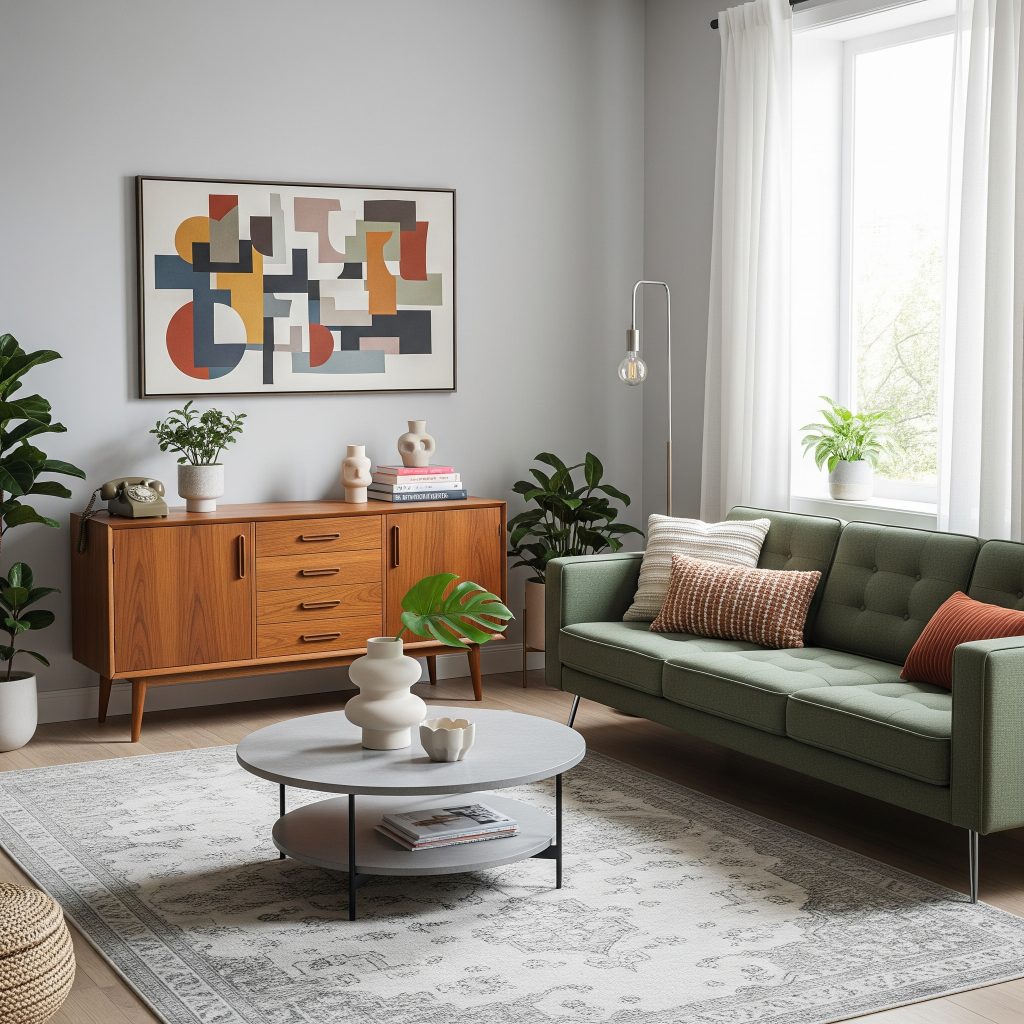
The Modern Vintage interior style is a curated aesthetic that seamlessly blends the best of the past with the freshness of contemporary design. It moves beyond simply recreating a specific period, instead celebrating the character and story of unique vintage or antique finds by integrating them into a modern setting. By pairing a classic mid-century sideboard with a minimalist sofa or a rustic farmhouse table with sleek, modern chairs, this trend creates a space that feels both nostalgic and forward-thinking. The result is a home with a sense of history, personality, and effortless style that feels collected rather than decorated.
The Modern Vintage aesthetic is deeply rooted in the principles of designers who valued form, function, and enduring quality. Their works, often from the mid-20th century, are the very pieces that define this look. No discussion of mid-century design is complete without mentioning British masters. Robin Day, known for his innovative furniture designs, and Lucienne Day, his wife and a celebrated textile designer, championed a modern, optimistic aesthetic. Similarly, Ernest Race’s furniture, crafted from post-war materials, embodied a spirit of resourcefulness and elegance.
Beyond the UK, the mid-century period produced an incredible array of influential designers. Charles and Ray Eames pioneered furniture that was both playful and ergonomic. Alvar Aalto’s work in bent plywood is a hallmark of organic, Scandinavian design. The clean lines and use of natural materials found in the work of George Nakashima and Poul Kjærholm continue to inspire. Other masters like Florence Knoll and Gio Ponti created pieces that defined the sophisticated modern office and home, while Paul Evans and Hans Wegner pushed boundaries with their sculptural and masterful woodworking.
In a Modern Vintage space, one carefully selected piece can anchor the entire room. Instead of a new item, focus on a vintage sideboard, a classic armchair, or a unique coffee table. These pieces bring warmth and history. You can find a piece in its original condition or, for a truly bespoke touch, have it professionally restored or reupholstered in a modern fabric. This approach allows you to select an item with a classic silhouette and infuse it with a contemporary twist, making it your own.
The hunt for the perfect vintage piece is part of the fun. Local charity shops, like those run by Sue Ryder and The British Red Cross, are a great place to start, as are independent charity shops. Online, sites like eBay and the Facebook Marketplace are treasure troves for everything from mid-century classics to overlooked gems. For more curated selections of authentic vintage and antique items, you can explore specialist sites like 1stdibs, Vinterior, and Mustard Vintage.
Where to indulge your Modern Vintage dreams: spree vs splurge.
New Colonial is a fresh reinterpretation of the classic British Colonial style, which originated during the European expansion from the 16th to the 18th centuries. It’s a trend born of travel, blending the formality of traditional British decor with the natural materials, light tones, and exotic influences of far-flung locales in Africa, Asia, and the Caribbean. Unlike its historical predecessor, which could feel heavy and ornate, the “New Colonial” aesthetic strips back the opulence, favouring a modern, streamlined look. It’s particularly well-suited for kitchens and bathrooms, where its emphasis on natural textures and light, breezy palettes creates a sense of tranquil escapism from the UK’s often grey climate.
The New Colonial trend is all about a “less is more” approach, focusing on key elements to create an elegant and airy feel.
While few brands are exclusively “New Colonial,” many UK companies offer pieces that allow you to build the look.
While the classic New Colonial style draws from tropical and eastern influences, a truly British take can be created by looking to a local design icon: Cornishware. Renowned for its distinctive blue and white stripes, this pottery evokes the simple beauty of Cornwall’s blue skies and white-crested waves.
To apply this to a UK kitchen or bathroom, you can:
Where to indulge your New Colonial dreams: spree vs splurge.
As we’ve explored, the Autumn/Winter 2025 interior trends are not about passing fads, but about creating spaces that are both current and enduring. Whether you’re drawn to the immersive drama of a saturated space, the rich narrative of a modern vintage home, or the serene escapism of a new colonial retreat, the guiding principle remains the same: your home should be a reflection of you. By focusing on intentional choices and quality pieces—be they new or old, high-end or high-street—you can seamlessly transition your living spaces from season to season, creating a home that feels warm, inviting, and truly timeless.